
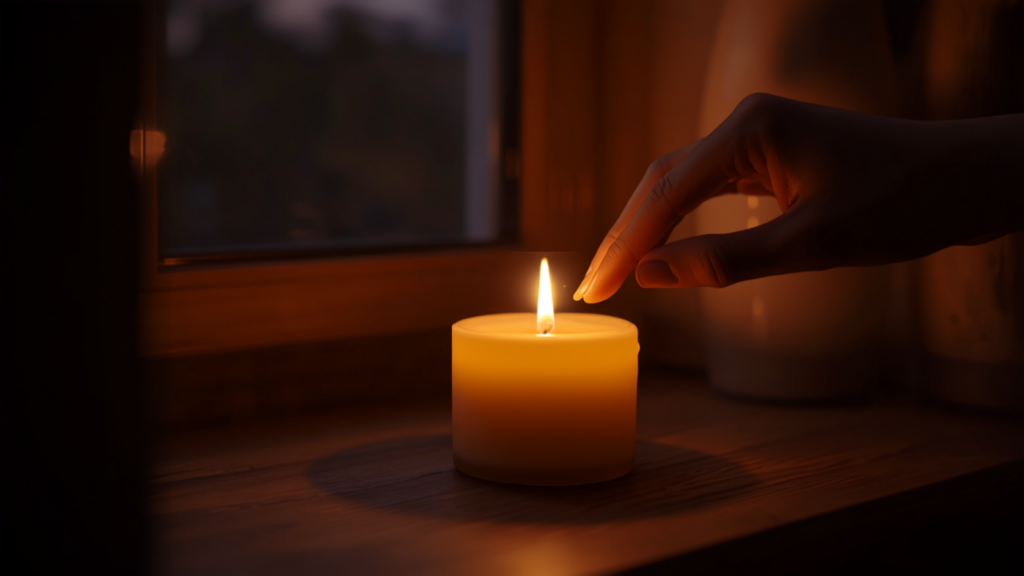
Candles have been used for more than 5,000 years, and their history doesn’t trace back to a single inventor. Ancient Egyptians, Romans, Chinese, Japanese, and Indians all independently developed their own candle-like light sources, each working with locally available fats, waxes, and plant materials. The wicked candle as we recognize it today, a fiber wick set in wax, is typically credited to the ancient Romans around 500 BC.
Over the five millennia that followed, candles moved through animal fat, beeswax, whale oil, paraffin, and eventually soy and coconut wax. They shifted from essential lighting to religious ritual to modern home décor. This article covers the full timeline, the materials, the civilizations, and the 5,000-year transformation from Egyptian reed torch to the candles sold today.
What Came Before Candles?
For most of human prehistory, fire itself was the only light after dark. Open fires worked outdoors and in large spaces, but they were difficult to control and impossible to carry safely inside a dwelling.
Oil lamps were an improvement. The earliest surviving oil lamps date to around 70,000 years ago, stone hollows filled with animal fat and a plant-fiber wick. They were widely used throughout the ancient world, but they had real limitations. The wick had to be pushed forward by hand as it burned down. The vessel holding the oil was easy to tip over. A knocked oil lamp in a dry-thatched home was a serious fire risk.
Torches worked well outdoors and in open spaces like processions and battlefields, but they produced too much smoke for enclosed rooms.
What all of these had in common was instability. The appeal of the candle, when it eventually came, was that it combined the fuel source and the wick into one self-contained, portable, upright object. You could set it down. You could carry it. It stayed lit without constant attention.
That design problem, portable controllable light, drove independent invention across multiple continents over thousands of years.
The First Candles: Ancient Egypt (Around 3000 BC)
The earliest known candles are attributed to ancient Egypt, dating to around 3000 BC. They weren’t candles in the way we use the word now, they had no wick. Egyptian chandlers made what are called rushlights: the pithy inner core of a reed was dried, soaked in melted animal fat (usually tallow, rendered from beef or mutton), and lit. The fat-soaked reed burned, gave off light, and that was enough.
Rushlights were cheap to make and widely used. They served practical purposes, lighting homes and workspaces after dark, and ceremonial ones. Egyptian temples used them in religious rituals, and evidence suggests they were placed in tombs to light the path of the dead into the afterlife.
The key limitation was stability. A rushlight was essentially a stick dipped in fat. It had no way to stand upright on its own, produced significant smoke, and burned unevenly. The wax and wick combination that would solve these problems wouldn’t appear for another 2,500 years.
The Romans and the First True Wicked Candle (Around 500 BC)
The ancient Romans are generally credited with developing the first true wicked candle, the direct ancestor of every candle burning today.
The method was simple but effective: a length of papyrus was rolled tightly and dipped repeatedly into melted tallow or beeswax. Each dip added a thin layer. Enough layers and you had a candle with a wick at the center and a solid wax body around it. When lit, the wick drew the melted wax upward through capillary action, feeding a steady flame.
Roman candles were used to light homes, guide travelers at night, and illuminate religious ceremonies. The design worked well enough that the fundamental principle, wick embedded in wax, has not changed in 2,500 years.
One note on the date: ancient Roman candles predate 500 BC according to most historians, but 500 BC is the commonly cited conservative estimate. The Romans likely refined an earlier form rather than inventing the concept from scratch.
Candles Across Ancient Civilizations: Independent Invention
Egypt and Rome are the civilizations most commonly cited in candle history, but they weren’t alone. Across Asia and the Americas, other cultures developed their own versions of candle-like light, independently, using whatever materials were available locally.
China.
The earliest surviving candle ever found was discovered in the tomb of the first emperor of the Qin Dynasty in China, dating to around 200 BC. Early Chinese candles were made in paper tubes, using rolled rice paper as the wick and a wax derived from a local insect species combined with plant seeds. During the Han Dynasty (206 BC–220 AD), whale fat was also used in candle production.
Japan.
Japanese candlemakers extracted wax from the nuts of the sumac tree, a material that burned cleanly and held its shape well. Japanese candles later became known for their quality, and traditional Japanese candle-making remains a craft practice today.
India.
In India, wax for candles was made by boiling the fruit of the cinnamon tree. These candles carried a natural, inherent fragrance, an early precursor to the scented candle concept, though the scent was a byproduct of the material rather than a deliberate addition.
North America.
Indigenous peoples of the Pacific Northwest, Alaska, and coastal Canada used a different approach entirely: the eulachon, a small oily fish also known as the candlefish. When dried, an eulachon contains so much oil that it can be placed on a forked stick and lit directly like a torch. The fish itself was the candle.
The wider point is this: candle-like light technology didn’t spread from one civilization to the others. It was invented independently, in multiple places, because the need for portable, controllable light is universal. The specific materials differed entirely, but the problem being solved was identical.
This independent-invention framing matters because it changes the answer to “who invented the candle?” The honest answer is: no one did, and many people did, depending on how you define a candle and which century you’re asking about.
The Middle Ages: Beeswax, Tallow, and the Chandler’s Trade (500–1400 AD)
By the early Middle Ages, candles were in widespread use across Europe, but not everyone was burning the same kind.
Tallow candles were the standard for ordinary households. Tallow is rendered animal fat, usually beef or mutton, and it was cheap and abundantly available. The problem was the smell. Tallow burns with a smoky, acrid odor that modern descriptions tend to understate. Imagine the persistent smell of singed fat filling every room every evening. For most of medieval Europe, that was the cost of having light indoors.
Beeswax candles were an entirely different experience. Beeswax burns cleanly, produces almost no smoke, and emits a faint natural sweetness. They were superior in every practical way, and priced accordingly. Beeswax candles were used in churches and by the wealthy. Ordinary households could not afford them for everyday use.
This gap between tallow and beeswax created the medieval candle trade. By the 13th century in England and France, candlemaking had become a guild craft. Chandlers, the craftspeople who made and sold candles, organized into guilds with regulated trade standards. The chandler’s trade was divided: tallow chandlers supplied households, while wax chandlers supplied churches and wealthy patrons.
Many chandlers worked itinerantly, traveling from house to house to make candles using the kitchen fats that households saved specifically for that purpose. Others operated fixed candle shops.
Religious use.
Candles held deep ceremonial significance throughout the Middle Ages. The Roman Emperor Constantine ordered candles used during Easter services as early as the 4th century AD. Hanukkah, the Jewish Festival of Lights, dates its candle-lighting traditions to events of 165 BC. In Catholic practice, candles represented the light of God and were central to Mass, baptisms, and funerals. The demand from the church was a major driver of the beeswax candle trade, and of the beekeeping industry that supplied it.
Colonial America and the Spermaceti Era (1700s)
The next significant development in candle materials came from two very different sources: a North American shrub and the ocean.
Bayberry candles.
Colonial American women discovered that boiling the grayish-green berries of the bayberry bush produced a wax that burned cleanly and smelled pleasant, a dramatic improvement over tallow. The catch was the labor involved. Extracting enough wax from bayberries to make a single candle required processing hundreds of berries. Bayberry candles remained a small-scale tradition rather than a widespread solution, and they are still made today as a specialty item.
Spermaceti.
The bigger shift came with the growth of the American whaling industry. Sperm whales contain a substance in their heads called spermaceti, a waxy oil that, when crystallized, produces an exceptionally good candle wax. Spermaceti candles burned brighter than tallow or beeswax, produced no unpleasant odor, and were harder than both, meaning they held their shape in summer heat without bending or softening. The first standardized candles, used as a unit of measurement for light output, were made from spermaceti wax. The term “candlepower” originates from this era.
The 19th Century: From Craft to Industry (1800s)
The 1800s transformed candle production entirely. In under 60 years, candles went from a handcraft guild product to a mass-manufactured commodity available to almost anyone.
1820s: Stearin wax.
French chemist Michel Eugène Chevreul discovered how to isolate stearic acid from animal fatty acids. The result was stearin, a hard, clean-burning, durable wax that could be molded easily and held its shape well. Stearin candles remain common in Europe today.
1834: Mechanized production.
Joseph Morgan, a craftsman from Manchester, England, patented a machine that could produce molded candles continuously, using a cylinder with a movable piston that ejected finished candles as they solidified. The machine could produce roughly 1,500 candles per hour. The era of handcrafted candles was effectively over for mass supply.
Also around this time, chandlers began braiding cotton wicks tightly enough that they curled over on themselves as they burned, a self-trimming design that eliminated the need to manually cut the wick during use.
1850s: Paraffin wax.
Scottish chemist James Young developed a commercially viable method for extracting paraffin from coal and oil shales. Paraffin wax was odorless, a clean bluish-white color, and burned consistently. Most importantly, it was far cheaper to produce than any previous candle material. When combined with stearin to raise its melting point, paraffin became the dominant candle wax almost immediately, and it still accounts for the majority of commercial candles made today.
1879: The lightbulb.
Thomas Edison’s commercial electric light didn’t kill candles, but it ended their reign as a primary light source. Candle production declined sharply in the decades that followed.
The 20th Century Comeback
Candles didn’t disappear after the lightbulb, they adapted.
The U.S. oil and meatpacking industries growing through the early 20th century produced paraffin wax and stearic acid as low-cost byproducts. That kept candle materials cheap and candle manufacturing active, even as electric lighting spread.
Candles remained a steady but unremarkable product until the mid-1980s, when the market shifted. Consumers started buying candles not as light sources but as décor, gifts, and mood-setters. The industry responded: candles multiplied in size, shape, and color. Scented varieties moved from specialty to mainstream.
The 1990s brought another change in materials. Agricultural chemists in the United States developed soy wax, specifically Michael Mikovch and Bob Maxfield, working at the University of Missouri in 1991. Soy wax is made from hydrogenated soybean oil, burns cooler and slower than paraffin, produces less soot, and comes from a renewable crop rather than petroleum. It quickly attracted buyers who wanted a cleaner, more natural candle.
Other waxes followed in subsequent decades: palm wax, coconut wax, apricot wax, and rapeseed wax, along with various blended formulations combining two or more of these with paraffin or with each other. The modern candle market is more varied in materials than at any point in its 5,000-year history.
When Were Scented Candles Invented?
The idea of a fragrant candle is almost as old as candles themselves, though the fragrance was rarely intentional at first.
India’s early candles, made from cinnamon tree fruit wax, carried a natural spice scent as a byproduct of the material. Colonial American bayberry candles were prized partly for their pleasant smell. These weren’t designed as scented candles; the fragrance was simply a property of the wax.
In medieval Europe, beeswax candles had a faint natural sweetness that tallow candles lacked, part of what made them desirable beyond their cleaner burn. Churches that could afford beeswax often burned incense alongside, blending the wax scent with myrrh and frankincense during services.
Deliberately scented candles, made by adding fragrance to the wax during production, are a modern industrial development. Synthetic fragrance oils became widely available in the 20th century, and candle manufacturers began adding them to paraffin wax as a selling feature. The practice accelerated through the 1980s as the gift and wellness markets for candles expanded.
The 1990s aromatherapy trend pushed scented candles into mass-market retail, with essential oil candles marketed for relaxation, focus, and mood. Today, fragrance is arguably the primary purchase driver for consumer candles, the scent matters more to most buyers than the wax type, the wick material, or the burn time.
Candles Today: From Utility to Ritual
Candles are no longer a primary light source anywhere in the developed world. That happened 150 years ago when reliable electric lighting arrived. What candles became instead is something that would have surprised anyone living before the 20th century: a luxury product driven almost entirely by atmosphere.
Today’s candle market is large by any measure. The global candle industry generates billions of dollars annually, with the United States alone accounting for roughly $3 billion in retail sales per year. The dominant consumer drivers are fragrance, home décor, wellness, and gifting, not light.
The materials in use reflect a more environmentally conscious market than past centuries. Paraffin still accounts for the majority of commercial candle production worldwide, but soy, beeswax, coconut, and blended waxes now occupy a significant and growing share, particularly in the artisan, specialty, and direct-to-consumer segments. Buyers increasingly want to know what their candle is made of and where the ingredients come from.
What hasn’t changed across 5,000 years is the dual function. Candles have always served two purposes simultaneously: practical illumination and something harder to name, ceremony, comfort, meaning, presence. Ancient Egyptians used them in tombs. Romans lit them in temples. Medieval households burned them on feast days. Today, people light them for birthdays, grief, meditation, a quiet evening, or simply because the room looks better with one burning on the shelf.
At Soveka Candles, we work within that same tradition, candles as objects that carry more than just light. Whether you prefer soy, beeswax, or a blended wax, the 5,000-year arc from Egyptian reed torch to the candle on your table is one of the more quietly remarkable material histories in human culture.
Frequently Asked Questions
Who invented the first candle?
No single person invented the candle. The earliest candle-like objects, rushlights made from reeds soaked in animal fat, are attributed to ancient Egypt around 3000 BC. The first true wicked candles, with a fiber wick embedded in wax, are credited to the ancient Romans around 500 BC. Multiple other civilizations, including those in China, Japan, India, and North America, independently developed their own versions around the same period. The candle wasn’t invented so much as it was discovered, separately, by every culture that needed controlled indoor light.
Were candles used in the Bible?
Yes. Candles and lamps appear throughout both the Old and New Testaments. The menorah, a seven-branched candelabra, is described in the Book of Exodus and remains a central symbol in Judaism. Hanukkah, the Jewish Festival of Lights, commemorates events of 165 BC and centers on the nightly lighting of a nine-branched menorah called a chanukiah. In the New Testament, candles and lamps appear in several parables. The Roman Emperor Constantine ordered candles used during Easter services in the 4th century AD, establishing a tradition that continues in Catholic and Orthodox Christian practice today.
When were scented candles invented?
Fragranced candles in a rudimentary form date to antiquity, India’s cinnamon-wax candles and Colonial America’s bayberry candles both carried natural scents as properties of the wax materials used. Deliberately scented candles, made by adding fragrance oils to wax during production, are a 20th-century development. They became a mainstream consumer product in the 1980s and accelerated through the 1990s aromatherapy trend. Today, fragrance is the primary purchase factor for most candle buyers.
What was used before candles were invented?
The main alternatives to candles were open fires, oil lamps, and torches. Oil lamps, hollow stone or clay vessels filled with animal fat or plant oil with a fiber wick, were the most practical indoor light source before candles. Their limitation was that the wick needed to be manually pushed forward as it burned, and the open oil vessel was easy to knock over. Torches produced too much smoke for indoor use. Candles solved both problems by containing the fuel source and the wick in a single stable, self-feeding structure.
What were candles made of in ancient times?
Ancient candle materials varied entirely by region and what was locally available. In Egypt and Rome, the wax was animal tallow, rendered beef or mutton fat. In China, candlemakers used wax from local insect species combined with seeds, or whale fat. In Japan, wax was extracted from sumac tree nuts. In India, cinnamon tree fruit was boiled to produce wax. In North America, indigenous peoples used dried eulachon fish, which are oil-rich enough to burn directly. Beeswax was also known and used in antiquity, but was expensive and less widely available than animal fats.
Conclusion
The history of candles is, at its core, a history of human ingenuity applied to a universal problem: how to extend the day beyond sundown. Ancient Egyptians soaked reeds in animal fat. Romans dipped papyrus in tallow. Chinese craftspeople molded insect wax into paper tubes. Every solution was different, and every solution worked, because the problem demanded one.
What followed across 5,000 years was a steady refinement of the same basic idea, wick and fuel, contained and portable. The materials changed: from tallow to beeswax, from whale oil to paraffin, from paraffin to soy. The uses changed: from survival necessity to religious ceremony to gift and décor. But the object itself, a wick drawing fuel upward to feed a flame, remains structurally unchanged from what the Romans were making 2,500 years ago.
The modern candle industry is worth billions globally. Thousands of small candle makers now produce artisan products in wax types that didn’t exist 40 years ago. Fragrance has become the central product value. And yet the candle on a birthday cake, the memorial candle lit at a service, the one burning on a windowsill on a winter evening, all of them connect directly to that first Egyptian torch lit in a dark room 5,000 years ago.
